



Cobra
King 3D Printed Enzo Limited Edition Putter
The LIMIT3D ENZO Putter is fully 3D printed from 316L stainless steel to unlock a new level of stability and performance. Featuring an internal lattice design that redistributes weight to deliver higher MOI and stability in a head with the sound and feel of a one-piece milled putter. Featuring a single bend face balanced designed for the player with a more straight-back, straight-through stroke.
Features-
- Limit3d Design In Collaboration With HP - The LIMIT3D ENZO Putter is manufactured in collaboration with HP, utilizing their industry-leading Metal Jet 3D Printing technology. This innovative technology allows the LIMIT3D Enzo Putter to incorporate intricate lattice structures, optimizing weight distribution and enhancing performance. The result is superior sound and feel, higher Moment of Inertia (MOI), and increased stability on off-center hits.
- One-Piece 3d-Printed Steel Design - Precise layer-by-layer 3D printing creates a structurally optimized putter that maximizes weight distribution and balance. This innovative process allows for strategic weight placement, resulting in a higher MOI and increased stability for a more consistent roll. While delivering a true one-piece steel construction that eliminates the need for weight-saving pockets or sole plates that can disrupt feel, sound, and overall performance.
- Steel Face With Descending Loft Technology - Precesion milled from 316 L stainless steel the face design delivers a soft and responsive feel. Featuring LA GOLF’s proprietary Descending Loft Technology, which utilizes 4 descending lofts (4°, 3°, 2°, 1°) to mitigate delofting and the addition of loft through head delivery during impact providing optimal launch for unparalleled end-over-end roll performance.
- Precision CNC Milled Surfaces - Crafted with uncompromising precision, our putters are CNC-machined from 316L to perfection, delivering razor-sharp detailing, flawless aesthetics, soft & responsive feel, and tour-caliber accuracy.
- Adjustable Weighting - Whether you prefer a lighter touch for more speed or a heavier setup for enhanced stability, you can adjust the weight to suit your personal stroke and feel.
 Earn 140 points on this product Use golfoy points at Checkout and save upto 50% extra
 100% Original Product
 Warranty
 Free Delivery
 Pay on Delivery

- One-Piece 3d-Printed Steel Design
- Hosel - Single Bend
- Steel Face With Descending Loft Technology
- Precision CNC Milled Surfaces
- Adjustable Weighting
| Country of Origin | China |
|---|---|
| Manufacturer | Cobra,China |
| Returnable | No |
| Replacement Period | No |
| Warranty | Limited 1 Year Manufacturer's Warranty Against Manufacturing Defects (Club Heads Only) |
| Brand | Cobra |



Determining the arc:
There can be three types of putting strokes:
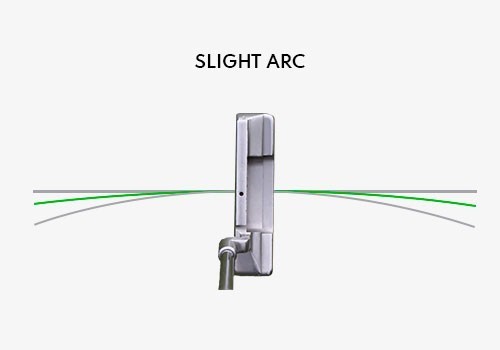

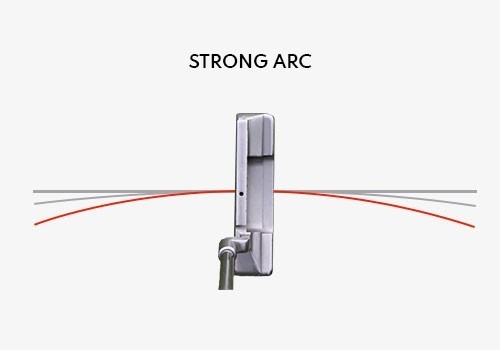
- Straight Back – Straight Through
- Slight Arc
- Strong Arc
Here’s an easy way you can imply to find it out for yourself: keep two alignment sticks putter head width apart and make a few putts. You can even record it from behind for a more precise visual. See how the putter moves in relation to the alignment stick. The more the putter head moves away from the stick. The stronger the arc.
TYPES OF PUTTER HEADS:
| FEATURES | 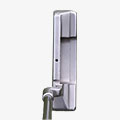 BLADES |
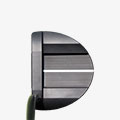 MALLET |
|---|---|---|
| LOOKS | Traditional looking putters featuring small heads | Modern looking putters featuring large heads |
| CHARACTERISTIC | Provides tremendous feel and control | Provides tremendous forgiveness |
| ALIGNMENT | Slightly harder to aim with and line up | Easier to aim with and line up |
| SWEET SPOT | Smaller | Larger |
| FORGIVENESS | Demands high precision hence not very forgiving | Highly forgiving |
| GREEN SPEED | Ideal for faster greens | Not the best performance on fast greens. |
| STROKE TYPE | Slight to strong arc | Straight back-straight through and slight arc |
| IDEAL FOR | Golfers with a consistent and repeatable stroke who want to prioritize precision and control on the green. | Golfers looking for greater consistency, balance and alignment on the green |
| FOR BEGINNERS | Not advisable | Advisable |
BALANCE:
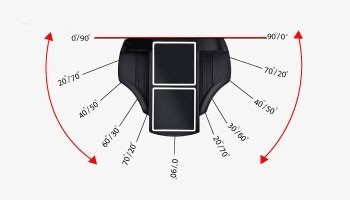 FACE BALANCED FACE BALANCED |
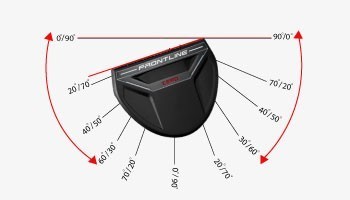 MID HANG MID HANG |
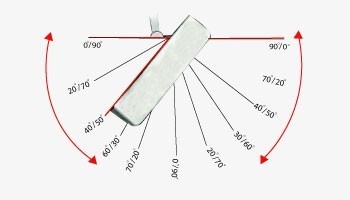 TOE HANG TOE HANG |
|---|---|---|
| Face points up to the sky | Toe points down to the ground slightly | Toe points down to the ground |
| Even weight distribution through the toe and heel | Weight favouring the toe slightly | More weight on the toe |
| 0 Degree of toe hang | >30 Degree of toe hang | <30 Degree of toe hang |
| Minimal face rotation through the stroke | Medium face rotation through the stroke | Maximum face rotation through the stroke |
| Ideal for players with a straight back-straight through the stroke with minimal face rotation | Ideal for players with a slight arc in and medium face rotation through the stroke | Ideal for players with a strong arc with high face rotation through the stroke |
| Ideal for players who tend to miss putts towards left | ideal for players who tend to miss putts to the right | Ideal for players who miss putts to the right |
PUTTER FACE CONSTRUCTION
| FEATURES |  INSERT |
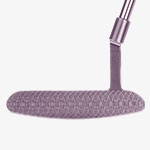 MILLED |
|---|---|---|
| CONSTRUCTION AND MATERIALS | Feature a face insert made from a different material than the putter head itself which is often made of softer materials like urethane, aluminum, or elastomer. The insert is either bonded or mechanically attached to the putter head. | Typically made from a solid block of metal, such as stainless steel or carbon steel. They are precision-machined using a milling process, which removes excess material to create the final shape and design. |
| SOUND | Produce a softer sound due to the insert material's dampening properties. The sound can be more muted and less audible compared to milled putters. | Due to the solid metal construction, milled putters tend to produce a crisp and distinct sound at impact. The sound can vary depending on factors such as the metal used and the design of the putter head. |
| FORGIVENESS | Tend to provide more forgiveness on off-centre strikes due to the softer insert material. The insert helps reduce the loss of distance and accuracy on mishits. | Generally less forgiving on off-centre strikes since the solid metal face doesn't offer as much forgiveness. However, some models incorporate design elements like weight distribution and perimeter weighting to enhance forgiveness. |
| SWEET SPOT | Typically have larger sweet spot | Typially have smaller sweet spot |
| FEEL | Soft | Firm |
| PRICE RANGE | Cheaper because of the materials used. | More expensive because of the milling process. |
HOSEL TYPE:
Putters come in various hosel types, which refer to the connection point between the putter head and the shaft. The hosel design can affect the putter's performance, feel, and alignment. Here are some common hosel types found in putters:
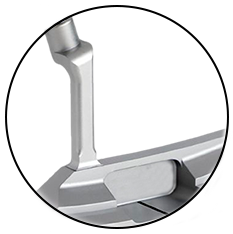
This hosel type has a curved or offset bend that connects the shaft to the putter head. It creates a slight toe hang, where the toe of the putter head points downward when balanced on a finger. Plumber's neck hosels are popular in blade-style putters and can promote a slight arc in the putting stroke.
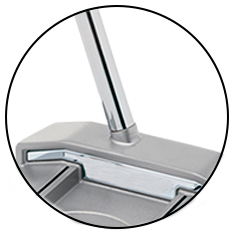
In this design, the hosel is positioned closer to the heel of the putter head, which results in a centre-shafted appearance. Heel shaft hosels are typically found in mallet-style putters and can offer improved alignment and a more face-balanced configuration.
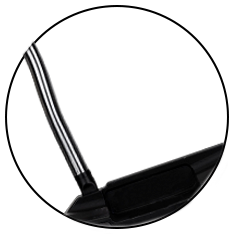
This hosel type features two bends in the shaft that connect to the putter head. It often creates a face-balanced configuration, where the putter face points directly upward when balanced on a finger. Double bend hosels are commonly used in mallet-style putters and can suit golfers with a straight-back-straight-through putting stroke.
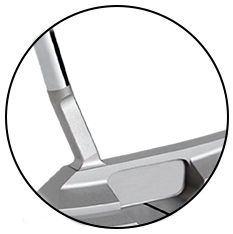
Slant neck hosels have a forward-leaning bend that connects the shaft to the putter head. This design often produces a moderate toe hang, promoting a slight arc in the putting stroke. Slant neck hosels are commonly seen in both blade-style and mallet-style putters.
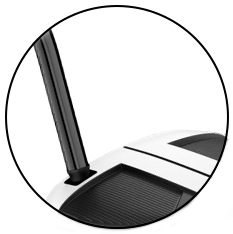
A single bend putter shaft has a minimal bend in the shaft about the width of half the shaft. This allows your hands to be slightly more in line with the ball. Almost all the single-bend putters are face balanced. A single-bend putter tends to be the best option for the golfer that wants a clean look at the address, one that sets them up for more accuracy and consistency. Lower handicap players like the single bend putter because it makes it easier to square the clubface up.
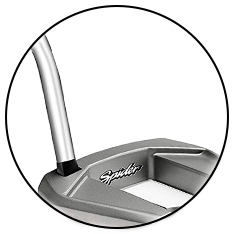
If you are a golfer with more of an arc style stroke, the flow neck could be a good choice for you. The flow neck has less offset. In addition, the flow neck gives golfers more toe hang. Helps players stand a little further from the ball and ensure the putter is more square at impact. Won’t work well for a golfer that is more mechanical and less feel oriented.
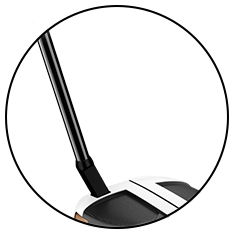
In recent years, the short slant has become the most popular hosel type for modern TaylorMade putters. This Tour-proven design, used by the likes of Rory McIlory, Dustin Johnson and more, provides the best of both worlds.
It's very compact and helps dictate a wonderfully square face at address while also letting the golfer frame the ball very nicely. Because of its slight toe hang, it can be used either by golfers with a stacked setup (eyes over the ball) or players who stand more upright and produce an arced stroke (eyes inside the ball). The beauty is in the versatility. Players with an arced stroke (inside, square, inside) who opt for this hosel may benefit from adding length to their putter.